
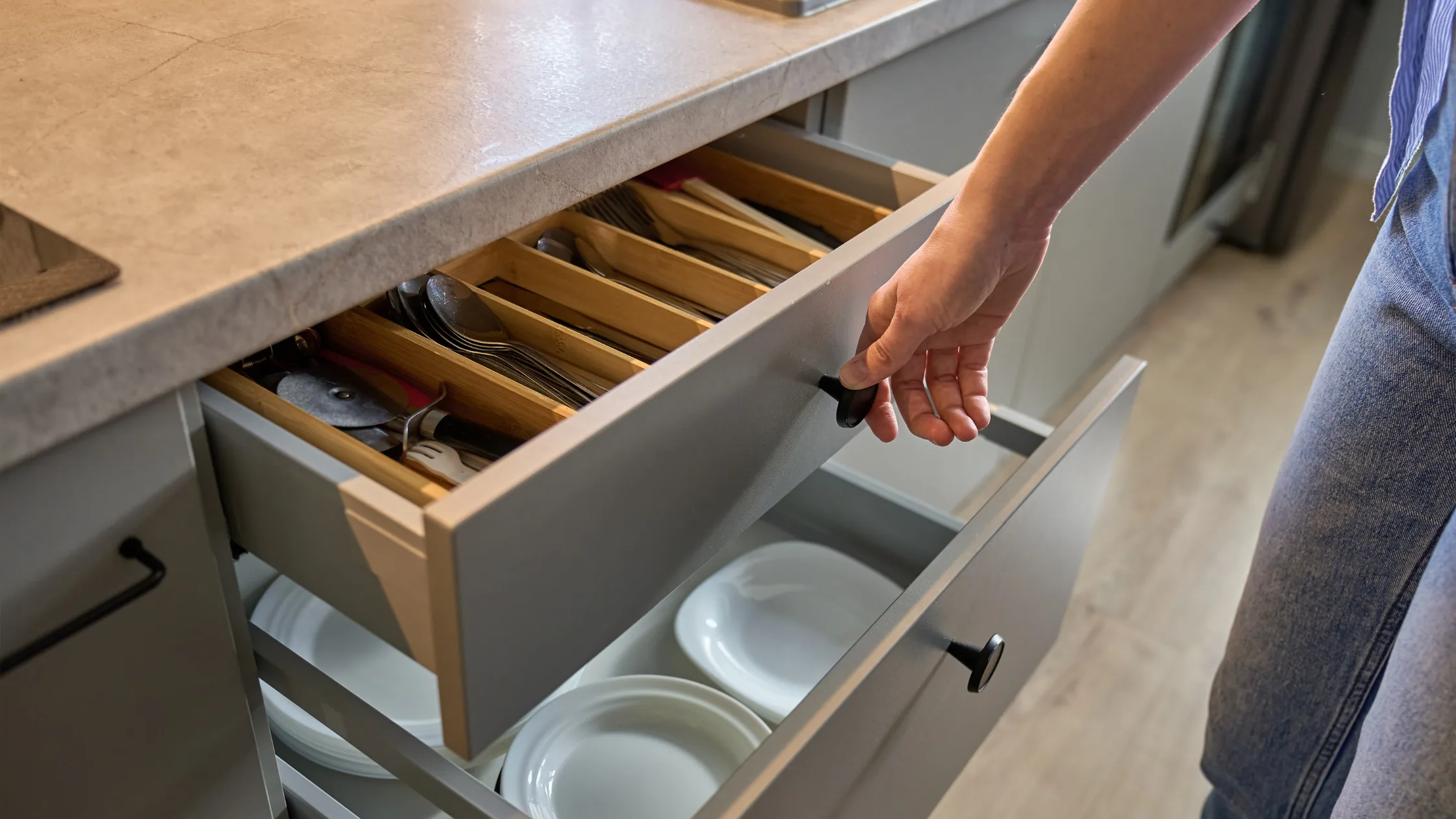
The flat-pack vs custom cabinet debate comes up in almost every consultation I have. Most clients have done their research online, seen the price difference, and want to know if it's actually worth it. Here is the honest answer — and it includes things the flat-pack showrooms will not tell you.
What Is Flat-Pack Cabinetry?
Flat-pack cabinets (sold by IKEA, Kaboodle, and similar brands) are pre-manufactured in standard sizes — typically 300mm, 450mm, 600mm, 900mm wide. You buy them off the shelf, assemble them on site, and fit them to your kitchen.
The appeal is obvious: lower upfront cost, readily available, visually reasonable in a showroom. The problems only become apparent when you try to fit a standardised product into a space that was never designed around those exact dimensions.
The Hidden Cost of Flat-Pack: Filler Panels
Every Auckland kitchen has walls that are slightly out of plumb, corners that aren't exactly 90 degrees, and ceiling heights that vary. Standard cabinet modules cannot accommodate these variations — so installers fill the gaps with filler panels.
Filler panels are exactly what they sound like: strips of material added to cover the difference between where the cabinet ends and where the wall is. In a 3.6m kitchen wall, you might end up with 50–120mm of total filler across several locations. That wasted space is not usable. It is dead space dressed up to look intentional.
In a custom kitchen, there are no filler panels. Every cabinet is manufactured to the millimetre of your actual walls. The result is a kitchen that looks genuinely built for your home — because it was.
Side-by-Side Comparison
Flat-Pack Cabinets
Custom CNC Cabinets
What Flat-Pack Salespeople Won't Tell You
1. The "Cheap" Price Doesn't Include Labour
When you see a flat-pack kitchen advertised at $5,000, that is the cost of the materials only. Installation — demolition of the old kitchen, assembly, plumbing reconnection, electrical work, tiling, and painting — typically adds $8,000–$15,000 on top. The end cost is often not as different from a mid-range custom kitchen as it first appears.
2. Standard Sizes Force Layout Compromises
Flat-pack systems come in fixed module widths. If your ideal pantry cabinet would be 520mm wide to fill the space perfectly, you're choosing between 450mm (with 70mm of filler) or 600mm (which doesn't fit). Custom cabinetry has no such constraint. We build to exactly 520mm if that's what the space needs.
3. Corner Cabinets Are a Particular Problem
Corners are where flat-pack systems struggle most. Standard corner solutions — lazy susans, blind corners — are compromises designed to hide the fact that standard-size modules cannot cleanly meet at an angle. In a custom kitchen, corners are designed as part of the whole layout, not bolted-on afterthoughts.
4. The Total Cost of Ownership Is Higher
Flat-pack cabinets are generally not designed for 15–20-year lifespans. The particleboard construction swells with moisture, hinges wear out, and the look dates faster. A quality custom kitchen built with solid construction and Blum hardware will outlast a flat-pack installation by a decade or more — and look better doing it.
When Does Flat-Pack Make Sense?
To be fair: flat-pack is a reasonable choice for rental properties, short-term renovations before selling, or situations where budget is genuinely constrained with no flexibility. If you are planning to live in the house for 10+ years and cook in the kitchen regularly, flat-pack is a compromise you will notice every day.
The InVogue Kitchens Approach
We manufacture all cabinetry in-house using CNC machinery in our Auckland facility. Every cabinet is built to the exact dimensions of your room, with Blum soft-close hardware as standard. The result is a kitchen that fits your home as though it was always there — because it was designed and built specifically for it.
Our 10-day manufacturing turnaround after sign-off means you are not waiting months for a custom kitchen. Exact fit and fast turnaround are not mutually exclusive.
See the difference
Talk to Us About Custom Cabinetry
We will show you exactly what custom-fit cabinetry means for your specific kitchen and give you honest pricing.